
Europeans against freedom
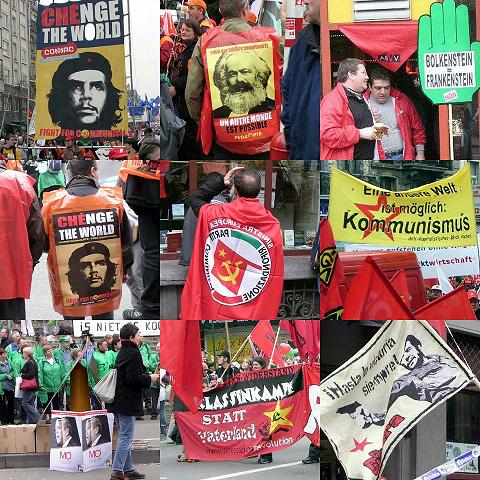
Last Saturday, a few days after Lebanese people had demonstrated for freedom, some 60,000 Europeans were demonstrating in Brussels against more freedom. The target of their protest: the liberalization and deregulation of services, addressed by the European Commission in the so-called "Bolkestein directive". But first, here's a visual impression of this anti-freedom march, with pictures courtesy of the Bruxelles Ma Ville blog.
THE BOLKESTEIN DIRECTIVE AND THE PRINCIPLE OF THE COUNTRY OF ORIGIN
The directive for the liberalization of services was written by Frits Bolkestein, the previous European Commissioner for the Internal Market. According to his directive, European service providers should be able to deliver their services in each European country on the basis of their statute in their country of origin, and based on the rules of their country of origin. Trade unions say that this will lead to "social dumping" practices, as rules in Eastern European countries are often less rigid than in Western Europe. So, they say, Eastern European construction companies would be able to let their low-wage employees work in high-wage countries. Which is simply not true, because labor regulations are not part of the Bolkestein directive.
FRENCH PUBLIC OPINION IS TURNING AGAINST THE NEW EUROPE
ESSENTIAL PART OF THE LISBON STRATEGY
The Bolkestein directive is the most vital part of the Lisbon Strategy, the great plan of the European Commission to make Europe the most competitive economy in the world by 2010. While the Lisbon Strategy was issued in 2000, by now it has become clear that the target is impossible to reach by 2010, with or without the Bolkestein directive. But it remains clear that the liberalization of services is the most important tool for working towards the Lisbon Strategy, as 70% of the European economy consists of services.
HAYEK INSTITUTE: "UNSUSTAINABLE SOCIAL PRIVILEGES"
There is an element of truth in the sad slogans of this tired nation: The Bolkestein directive poses a direct treath to the crest of social privileges in Western Europe, which is simply unsustainable from an economic viewpoint. The creative forces of competition which will be liberated by the directive, will force Western Europe to purify its legislation, to lower its labor-parasiting taxes, and to diminish the cost of labor. The Bolkestein directive will only accelerate an evolution that can never be stopped by the incantations of Old Europe, an evolution that is called "globalization", i.e. free trade between individuals, wherever they are on the planet.
NOT RETRACTED, BUT TO BE REWRITTEN
At the European summit on Wednesday, heads-of-state and government leaders have not retracted the Bolkestein directive, but they have decided that it will be "rewritten". Changes are that its implementation will be delayed for months if not years. The Financial Times writes:
The dispute over the services directive is a symptom of the political resistance to free market solutions to Europe's woes, particularly in countries such as France and Germany where unemployment is close to 10 percent.
FLEMISH LIBERALS DIVIDED

As a member of VLD, I'm disappointed by this insult to the principle of free trade, another example of a center-right politician trying to please the left while being ashamed of his own ideology.
Dewi Van De Vyver, the president of the Young Liberals, is as shocked as I am:
We urge prime minister Guy Verhofstadt to read the Bolkestein directive again, to dust off his free market principles, and to stop howling with the antiglobalist, protectionist and economically conservative wolves. The risk for social dumping does not exist. The directive, diabolized by trade unions, does not deregulate minimum wages, labor conditions, holiday regulations, nor work hazard, health and safety regulations. For all these crucial aspects, the regulations of the country where the work is carried out will be applicable.
FRENCH XENOPHOBIA
Frits Bolkestein, a Dutch liberal and author of the directive, says it is not exceptional that a directive is rewritten. But he accuses the French of xenophobic feelings towards his person, as the protesters used the slogan "Bolkestein = Frankenstein". "They clearly stressed the fact that my name is not a French name, and they played on the anti-germanic and anti-anglosaxon feelings of the French public", Bolkestein said. He added that the French are feeling that they are not at the center of Europe any more. French is loosing ground as a language within European institutions, and Europe is not following the direction that France had in mind.
BLEAK FUTURE FOR EUROPE
The patient is ill, but he does not like the taste of his medicine. The patient would like to become healthy and strong again. He even dreams of becoming the strongest man in the world by 2010. But, on the other hand, he likes his warm bed, his hot chocolate and his caring nurse, and it's so damn cold outside. The medicine is called "free markets", the warm bed is called "social protection", the hot chocolate is called "state-enforced redistribution of wealth", and the caring nurse is called "welfare state". European growth rates are averaging less than 2% this year, half the U.S. rate. Will Europe be in the top-3 of world economies by 2020? As things are standing now, I don't think so. Anyone wanna bet?


RSS feeds
 Artikels
Populaire inhoud
Van vandaag:
- Bij de "politieke" kersttoespraak van de koning
- Vette blunder in De Morgen, dikke pluim voor HLN
- VRT lacht met Marokkanen. Of nee, het zijn weer...
- CD&V ten oorlog tegen palmolie en kokosvet
- De Hoge Gezondheidsraad over palmolie
- FAQ over de Amerikaanse verkiezingsuitslag
- De TAC-test
- Etrusken kwamen uit Turkije
- Een rechter met gevoel voor humor
- De gebeurtenissen van het decennium
Van altijd:
- Originele nieuwjaarswensen
- De beste foto's uit de shame-betoging
- Evolutieleer voor beginners
- Zomertijd, wintertijd en astronomische tijd
- Amerikaanse bedrijven vormen geen bedreiging voor een open internet
- 10 nieuwe uitvindingen die de wereld gaan veranderen
- Dubbele regenboog
- De TAC-test
- Werkloosheid wenkt voor belspeldellen
- Luchtfoto's van drie provincies online beschikbaar
Reacties
B Degtyar
dinsdag, 20 september, 2005 - 16:01Peiter Klepto:
What an ignorant perception you have about what happened in Russia! The reforms of the 1990's were not responsible for the fact that the Soviet Union was bankrupt, that the Russian (and CIS) citizens were emerging from 70 years of such abject enforced poverty and suffering that most still live, to this day, in unheated, wood shacks with no electricity running water! The reforms of the 1990's have ensured the steady growth Russia is seeing. The pain is caused by the criminality that persists as imposed by former communist cronies who floated to the top of government buoyed by theft and corruption, the only methods of profit in a monopolist bureaucracy. It is so funny how one man sees another in a mercedes, while he himself drives only a Lada (russian car) and complains about the state of things, forgetting that last year neitehr he nor anyone he knew had any car at all!
The pain I feel in my heart as the fools pictured above praise mass murderers such as Che, and long for the idea of socialism, completely ignoring irrefutable evidence of its total failure as a system is bad enough - to read you dumping these problems as a result of the cure is astounding. When removing a Cancer, the chemo hurts, but it is the cancer that was doing the killing. Communism spreads quickly and kills as it grows.
kebajore
dinsdag, 9 augustus, 2005 - 16:57sparticus just agreeing that youre comment really did add an extra volume to my research thanks - just wondering you guys what you make of changes by lanker and gebhard seems a series of semantics to me - origin and mutual recognition!! and others a a bit dramatic Fritz calls it 'anti-democratic market radicalism' however i think theyre barking up the wrong tree with the origin thing - would freedom of establishment with 'antidiscrimination' not cause a spiral of further deregulation? surely that would cause more of a welfare loss than the origin principle!!
ispirati
dinsdag, 10 mei, 2005 - 01:17great! The collage is wonderful...
Barbara
vrijdag, 1 april, 2005 - 16:55Kook watch code yellow (elevated). No, JVS, that smoke is from those funny cigarettes Billy Coop is smoking.
JVS
donderdag, 31 maart, 2005 - 20:16Well, if we Google a bit on "zyklon" and "wojtyla" we find websites, some a bit obscure, like:
http://www.rense....
http://jdstone.or...
http://www.blackw...
(and many more)
This website tries to proof it's not true, but their arguments are not very strong:
http://www.cathol...
Funny is that one of the writers of this Pope-ZyklonB connection, William Cooper, was killed by the police under dubious circumstances. Apparently the authorities even changed the official version of his death.
Were the conspiracy jokers active again? Or is there no smoke without a fire?
LVB
donderdag, 31 maart, 2005 - 16:55@WC II: it is not relevant to the article, that's why it is not in the article. It was a direct response to Barbara's remark: "You know, Chirac's position reminds me very much of a senator from New York. The electorate doesn't really mind who he screws, or how corrupt he is as long as he takes care of his own".
John Paul II sold Zyklon B to the Nazi's? What kind of joke, or urban myth is that? If this were a proven fact, I would probably mention it when writing an in memoriam of him.
William Cooper II
donderdag, 31 maart, 2005 - 16:33Luc: "About Chirac: if he was not the president, he would probably be in jail by now".
So what? What is the relevance of this in this article? Will you from now on mention all the "dirty" side information of every person you write about? Or are you selective and you do it only with those having a different view than yours? You could have said the same about Berlusconi for instance.
Hope you don't forget to mention soon that the pope John Paul II sold Zyklon B, the deadly cyanide gas, directly to the Nazi camp at Auschwitz. And that he entered the priesthood in 1946 in order to escape arrest and trial as a Nazi war criminal.
dof
donderdag, 31 maart, 2005 - 09:50The Conditional in French is used both for hypotheticals and (as yet) unverified reports or hypotheses.
I think "allegedly" may a bit strong as translation goes, "according to ...", or "it is said" seems a bit more neutral. "Allegation" has, in my opinion, a strong negative connotation.
Barbara
woensdag, 30 maart, 2005 - 20:52No, your corrected translation actually makes more sense. Thanks for the lesson!
LVB
woensdag, 30 maart, 2005 - 17:46@Barbara: the French 'aurait' means 'would have', but in this context it does not mean 'would have' as a possibility, but as some sort of 'indirect sense', i.e. "somebody else said that". If I did not put 'allegedly' in the translation, you would think that I meant "If the program would be broadcast, Chirac would be angry". No, Chirac was angry when he heard of the planned broadcast, some say, so it is written in the indirect sense. Maybe there is a better way to put it in English, but if I had simply written "would have provoked the anger ..." you would think that I'm simply describing a possibility, which would not be correct.
About Chirac: if he was not the president, he would probably be in jail by now. Simply because the president is immune from prosecution, he escaped a conviction for bribery. See http://www.global...
Barbara
woensdag, 30 maart, 2005 - 17:38Luc: I don't read 'alledgedly' in the French but my French isn't as good as yours (though surprisingly serviceable). Still- I am having a hard time wrapping my mind around the notion that...oh, nevermind. I'll start sounding like a naive American if I say anymore.
You know, Chirac's position reminds me very much of a senator from New York. The electorate doesn't really mind who he screws, or how corrupt he is as long as he takes care of his own. The problem is that he exerts incredible and undue influence over the fates of millions who did not elect him. Belonging to the EU is a devil's bargain.
ivan
woensdag, 30 maart, 2005 - 13:00Belgian newspaper De Tijd (imagine!) also reports on this. I was it first in a very small corner of Gazet van Antwerpen. Apperantly it was no showcase program for Barroso. NO, Barroso was meant to defend himself against a panel of journalists and experts. Imagine how many of those panelists would be pro-Bolkestein!
henry
woensdag, 30 maart, 2005 - 09:00barbara-
state-run media, isn't that something? imagine the worldwide firestorm if bush ordered a news organization to ignore a political rival. a international media tsunami, i'd guess. yet, many european citizens don't care enough about state run/influenced medias to get rid of them/stop paying their tax euros for them. it boggles my mind to no end. the degree to which many europeans give their rights and best interests away is nearing communists levels with the eu referendum. i sincerely hope i'm wrong in ten years.
LVB
woensdag, 30 maart, 2005 - 02:11correction to the translation: "... to cancel the project which had allegedly provoked the anger of president Jacques Chirac".
LVB
dinsdag, 29 maart, 2005 - 23:19@Barbara, @Ivan: I have looked up more information about Raffarin's ban on Barroso television appearances.
The Times: http://www.timeso...
<<The Government has apparently cancelled an invitation to José Manuel Barroso, President of the EU Commission, to appear in a showcase programme on French TV. French media reports said M Chirac's entourage cancelled it because they feared that Senhor Barroso, with his strong 'liberal' views, would feed the 'no' vote. The Commission and M Chirac’s office yesterday denied any political intervention.>>
The official website of the French prime minister had an AFP news statement about this, but it has disappeared from the site. You can still find it in the Google cache: (you'll have to paste the following url together again:
h t t p://216.239.59.104/search?q=cache:jTkKiISvV6kJ:www.ddm.gouv.fr/
afp/francais/topics/internet/050325165442.mqwxnps1.php
<<L'hebdomadaire L'Express affirmait dans son édition du 26 mars que "le cabinet de Jean-Pierre Raffarin (le Premier ministre) s'est chargé de demander aux responsables de France Télévisions de renoncer au projet" qui aurait provoqué la "colère" du Président Jacques Chirac.>>
Translated: <<Weekly L'Express confirmed in its edition of March 26 that the cabinet of prime minister Jean-Pierre Raffarin has asked the management of French television to cancel the project which would have provoked the anger of president Jacques Chirac>>
I suppose the anger of Chirac was provoked by "the project" (i.e. a television debate where Barroso would appear), and not the question "to renounce the project".
Barbara
dinsdag, 29 maart, 2005 - 22:39How can he do that? What recourse do you all have? None? I plead ignorance but I am appalled.
ivan
dinsdag, 29 maart, 2005 - 21:25Talking about fascism. Prime minister Raffarin has forbidden to broadcast interviews and talkshows with Commission-president Barrosso.
Barbara
dinsdag, 29 maart, 2005 - 16:15Sorry Stephen: I meant from an economic perspective, but I might say that France is in the process of "projecting" guns, oppression and lots of it by signing up to sell arms to China. As bad, worse are those who cooperate with evil to benefit themselves.
Steven
dinsdag, 29 maart, 2005 - 11:12"By the way, what is the difference between 'etatiste' and Fascist? This is not meant to be a rhetorical question, but I sense that if there is a distinction, that it is a distinction without a difference."
Try this one: Guns, oppression, and lots of it too. It's one thing being a doctrinary free-marketeer, it's another to completely ignore history and make stupid remarks like the one above.
Barbara
zaterdag, 26 maart, 2005 - 17:19I am busy researching the Bolkestein directive to understand it and its implications but I would like to comment that German unemployment is nearly 13%. I read in an editorial recently (probably the Wall Street Journal) that Schroeder is now considering lowering the business tax rate from 25% to 19%, the same as Poland's.
Spartacus, I found your comment most helpful. If these controls don't work, it will be for the same reason that the EU itself won't work: it is attempting to engineer human activity to a degree that has already been proven unworkable.
By the way, what is the difference between 'etatiste' and Fascist? This is not meant to be a rhetorical question, but I sense that if there is a distinction, that it is a distinction without a difference.
Excellent post, Luc
Thierry
zaterdag, 26 maart, 2005 - 08:55Potok-Patek,
There were a lot more of them this day, believe me.
I just had no time enough to take all their pictures!
Potok-Patek
donderdag, 24 maart, 2005 - 22:57What a magnificent feat: managing to gather all living European commmunists in one photocollage!
Spartacus
donderdag, 24 maart, 2005 - 12:18* Well, that's just naïve to think that such a control could acutally (sic) work... *
Part of the consequences of the Directive is to set up an IT-system capable of integrating all laws & regulations of the member states. In that way, not only the country of origin can control the service provider but also the inspectors of the country where the service is provided.
The Bolkestein Directive cannot be implemented as long as a transparant system of quality control is not in place. What the trade unions fail to see is that such measures would INCREASE job security and observance of the laws ! After all, with the present day influx of Eastern European migrants (which is much larger than policy makers would care to admit) the potential benefit for an employer to hire Poles, Hungarians, Lithuanians,... illegally is very big. This encourages a full scale black economy (with no regards to safety regulations, environment,...).
The Bolkestein Directive will increase the transparancy of the entire economy, increase its legality and ensure that Poles who work in Dutch tulip fields will actually benefit from Polish labour laws and social agreements.
ivanhoe
donderdag, 24 maart, 2005 - 11:02first of all: you'e pictures aren't quite giving a correct image of the protest...Of course there were communists but you're pictures seem to tell: "look the protesters are communists so that's why because they are against it, not because the directive can be improved a lot."
The directive of course doesn't tell anything about labor regulations but it DOES say that the country of origin should CONTROL the obeyance to the regulations of the services given here.
Well, that's just naïve to think that such a control could acutally work...
But of course nothing against liberalisation of services in Europe. But it should be improved.
P.S. France is not the only country in which the government works more than close together with the industry but of course they don't call it etatisme in the USA.
Pieter Cleppe
donderdag, 24 maart, 2005 - 04:37I'd like to cite the following reaction on the very interesting weblog http://eureferend... .
I fully agree with that comment. Competition among governments is a very good thing, but not when it is originated and directed by a central authority, the EU, which has the decisive power to overturn its own decision and to centralise the whole thing. So be aware of the Bolkenstein directive! It's maybe not about free market, well let's say, the EU is maybe not about free market!
http://eureferend...
""Yes, well the Russians agreed to large-scale "economic reform", on the advice of eg the Harvard Business School, and the results were catastrophic not just in economic but in human terms. It simply is not possible to make a rapid transition from one established system to a completely different and incompatible system without taking casualties during the process, and if the casualty rate gets above a certain level there is usually a counter-revolution.
However my concerns about this Directive are twofold.
First, whatever the British government thinks or says now, the ECJ will inevitably find that it also applies to health services. As with postal services, there are arguments for and against privatisation - into which I will NOT be drawn - but the decisions about our health service should be taken by the British government, not by the EU.
Second, it is absurd to have (say) a clinic operating in this country, but under (say) Hungarian law. Is there going to be a notice at the door, warning potential patients that as they cross the threshold they are entering a zone where English law does not apply, and all contractual disputes will be settled under Hungarian law?
I know that recently the ECJ ruled that even if a contract laid down that it would be governed by the law of a specified Member State it was still permissible for a party to a dispute to get in first in a court
in another Member State.
There could only be one end result of the chaos that would inevitably ensue from service companies claiming to operate abroad under the law of their home Member State - some of which may take on a role similar to that of Liberia for the registration of ships. Eventually it would be agreed that there could be only one law for all the EU.
The real purpose of this Directive is not to "reform the European economy". It is "Europeanisation" masquerading as "liberalisation".
Ardent free marketeers might like to reflect that for all we know the "liberalisation" element may later be reversed, once it has achieved its purpose, and that decision would be out of our hands.
If the EU decided that there would only be a socialistic state-run European Health Service (the "state" being the EU), and no private competition in health services would be allowed anywhere within the EU, then that is exactly what would happen. There would be nothing that the vestigial British government could do about it, whichever party was in office, any more than in 1948 the county councils could prevent the Labour goverment nationalising their county hospitals."" (Denis Cooper)